Multilingual Websites with a Modern Solution

Multilingual Websites: Local and International Growth with the WPML Plugin and Automatic Translation

Introduction – Multilingual Websites

Reaching new markets and language groups is one of the most effective ways to grow a business. Building a multilingual website is easier than ever, thanks to the WPML plugin and its automatic contextual translation features. In this article, we explore how modern translation tools save time and how multilingual search engine optimization (SEO) ensures global visibility—without losing the local touch.

Introduction to the Challenge: Technical and Time-Related Hurdles of Multilingualism

Many companies’ expansion plans stall due to language barriers and technical complexity. When a business wants to offer its services in Finnish, English, and Swedish, for example, it often faces a massive amount of manual work. The traditional method of copying text from page to page, translating it in separate files, and manually managing links quickly leads to errors, outdated information, and a confusing user experience.

Beyond technical maintenance, the greatest challenge lies in search engine visibility. If search engines like Google do not understand the relationships between a site’s different language versions, the site may suffer from duplicate content penalties, or the wrong language version may appear in search results for a specific country. Implementing multilingual functionality therefore requires a tool that automatically handles both content translation and the underlying technical SEO structure.

Main Content: WPML and the Automation Behind the Efficiency

WordPress’s most popular multilingual plugin, WPML (WordPress Multilingual Plugin), offers a comprehensive solution to these challenges. It integrates seamlessly into site management and enables all content—pages, posts, menus, and even theme strings—to be translated from a single interface.

Automatic Contextual Translations Save Time

One of WPML’s most revolutionary features is its advanced automatic translation functionality. Unlike traditional word-for-word tools, WPML leverages AI-powered systems to deliver contextual translations. This means the system analyzes entire sentences and surrounding content, resulting in natural language where professional terminology and nuances are accurately preserved. This reduces the need for manual translation and significantly saves both time and costs.

Search Engine Optimization (SEO) Included in the Same Package

A multilingual website requires precise technical optimization. WPML automatically handles many critical SEO factors required by search engines. It creates a clear URL structure for each language version (for example, as a subdirectory like /en/ or via a domain extension) and adds the necessary hreflang tags to the pages. These tags tell search engines which page corresponds to which language and region, improving search visibility worldwide.

The table illustrates the differences between traditional manual translation and modern WPML automation, based on the information presented in the text.

FeatureTraditional Manual TranslationWPML and Automatic Contextual Translation
Translation SpeedSlow, requires copying and manually transferring textExtremely fast thanks to automation
SEO ReadinessRequires manual coding (hreflang tags, URL structures)Automatic management of structures and tags
Cost LevelHigh due to extensive manual workCost-effective thanks to AI-powered pre-translation
Contextual UnderstandingDepends on the translator, prone to copy-paste errorsAdvanced AI understands sentence context and nuances

Infographic: The 4 Steps of the Multilingual SEO Process in a WPML Environment
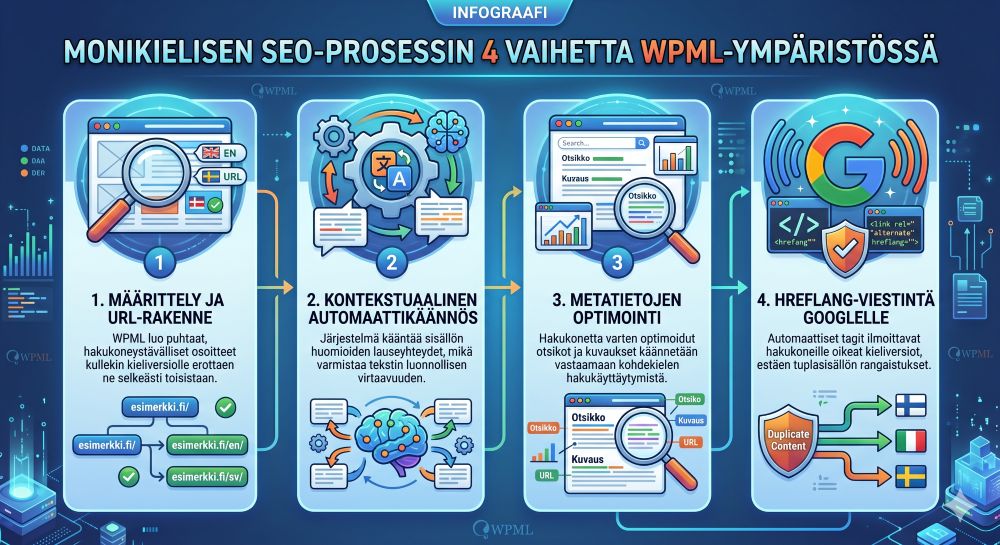
SEO Optimization and Search Visibility in Multilingual Website Optimization - Process Diagram
  1. Configuration and URL Structure: WPML creates clean, search-engine-friendly URLs for each language version, clearly separating them from one another.
  2. Contextual Automatic Translation: The system translates content while considering sentence context, ensuring natural text flow.
  3. Metadata Optimization: Search-optimized titles and descriptions are translated to match the search behavior of the target language.
  4. Hreflang Communication with Google: Automatic tags inform search engines of the correct language versions, preventing duplicate content penalties.

Practical Examples: From a Local Business to an International One

Consider a practical example of a company operating in the Kotka area and the broader Kymenlaakso region. The company provides logistics or tourism services and wants to reach English-speaking international partners in addition to Finnish-speaking customers.

Once WPML is installed on the site, Finnish service descriptions can be translated into English with just a few clicks. Automatic contextual translation ensures that professional terminology is accurately rendered. Simultaneously, the system creates an /en/ version of the site, translates menus, and handles SEO metadata. When a customer searches for services in English, Google directs them straight to the correct language version. The site administrator only needs to perform a light proofread, and the website is ready to serve a global audience.

Summary on Multilingual Websites

Multilingual websites are no longer a privilege reserved for large corporations. With the WPML plugin and automatic contextual translations, businesses of all sizes can reliably expand their visibility and enhance customer experience. Outsourcing technical SEO optimization to automation ensures that the site appears in search engines in the correct language, without the fear of technical errors.

When you want your website to serve as a solid digital home for your business, it is worth investing in the platform’s technical quality and hosting solutions. Reliable systems ensure that even a multilingual site loads quickly and operates securely in all situations.

For more information on best practices for multilingual sites, you can refer to the official WPML documentation as well as Google’s own guidelines on the Google Search Central website.

Considering a Multilingual Website?

Are you planning a new website for your business or looking to expand your current site to be multilingual? Bluepeak Oy (Business ID 3092462-6), headquartered in Kotka, helps you build effective digital solutions. We ensure that your website and its hosting solutions form a secure and efficient digital home for your business.

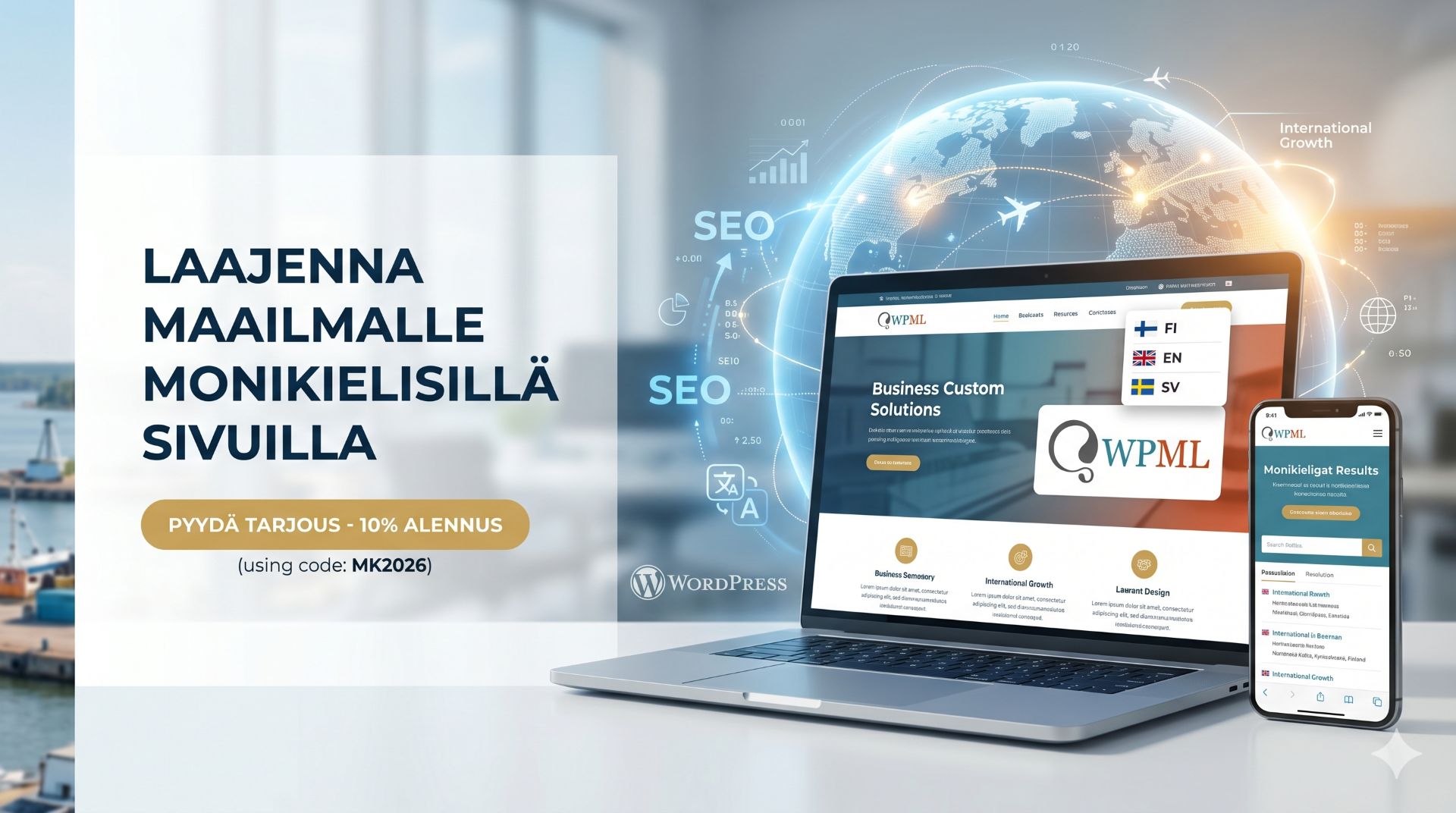
Take advantage of our special offer now: get a 10% discount on websites with code MK2026. Enter the code in the contact message field.

Explore our services and get in touch:

Why Centralize Your Digital Home?

A digital home should not be fragmented. This article presents current perspectives on the benefits of centralizing your digital home.

Time to Bring Digital Solutions Under One Roof

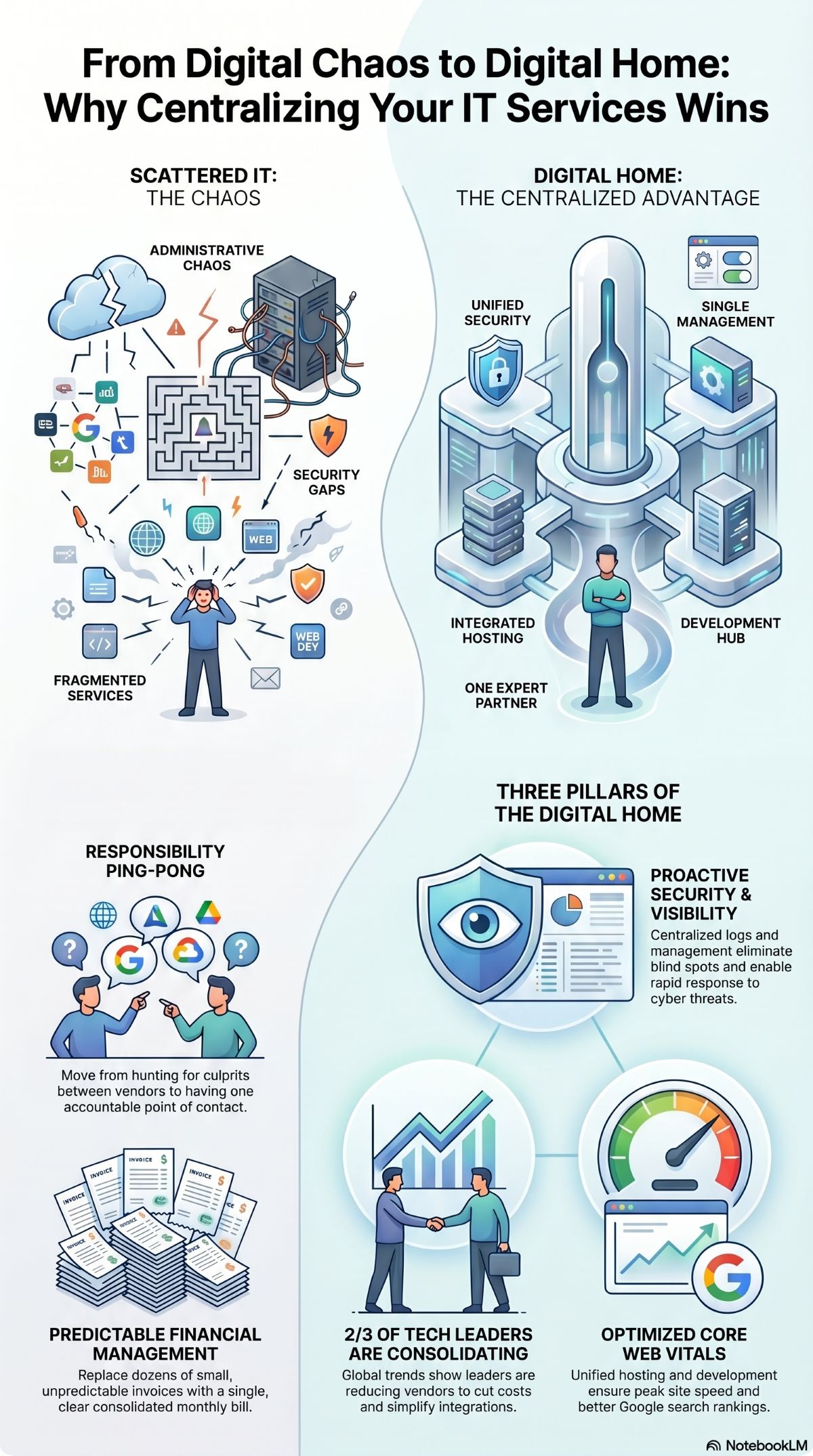
A company’s digital footprint today consists of numerous separate pieces: domain names, email services, websites, and server space. When these are distributed among multiple providers, the result is often administrative chaos, unexpected hidden costs, and latent security risks. In this article, we examine in detail why centralizing your digital home with one reliable partner saves time, money, and company resources for productive work.

Introduction: Pain Points of a Fragmented Digital Environment

Many companies’ IT and web environments have evolved over the years more by accident than by design. A domain may have been registered with one service provider years ago, the website’s visual development ordered from another digital agency, and the site’s hosting—the actual server environment—acquired from an international cloud service giant.
Complex architecture is not merely a technical disadvantage; it is a direct drain on the company’s budget. Each individual monthly fee, license, and update task accumulates unnoticed into a substantial annual expense. Even more costly is the work time employees spend searching for outdated passwords and communicating with various vendors’ customer support teams. Such a fragmented model works smoothly only until something unexpectedly breaks.
When website malfunctions occur or emails suddenly stop flowing, a painful and time-consuming blame game begins. Service provider A blames party B, and the website developer declares the problem lies solely with the server. Ultimately, the only real victim is the company itself, whose online business and customer acquisition are at a standstill. For this reason, an increasing number of organizations want to consolidate their services under a unified and clear “digital home.”
A centralized digital home solves the challenges of fragmentation.

1. Security and Manageability Improve Significantly

A fragmented web environment assembled from disparate pieces is always a significant security risk from an information security perspective. For example, the Finnish Transport and Communications Agency Traficom’s National Cyber Security Centre has emphasized in several publications the importance of an organization’s ability to comprehensively understand the scope of its own digital and cloud service ecosystem. Managing multiple isolated SaaS and cloud services in a fragmented manner creates blind spots in the network and slows response to serious threat situations.
The National Cyber Security Centre also advises that technical logs should be collected and analyzed centrally. If the web environment’s data and permissions are scattered across dozens of different platforms, rapid detection of anomalies becomes practically impossible. When all digital core pillars are reliably centralized under one roof, security updates, regular backups, and monitoring can be implemented seamlessly by a single expert partner.
Download: National Cyber Security Centre PDF

2. Time Is Genuinely Saved for Business Development

Continuously managing multiple service providers means multiple separate invoices, complex contracts, and dozens of contact persons. Based on thorough market surveys conducted by research firm Gartner, it is clear that the direction of IT procurement is shifting strongly toward consolidation. More than two-thirds of companies’ technology leaders are actively working to consolidate and reduce the number of their IT vendors.
Explore Gartner’s research.

The reason for this strategic shift is clear: A broad and fragmented vendor landscape complicates integrations between systems, significantly slows development work, and increases maintenance costs. A digital home implemented on a single-point-of-contact principle means you only need to reach out to one channel. Your company does not need to pay for intermediaries, and the saved IT resources can be directed toward sales and customer experience innovation.

3. Performance Maximization and Core Web Vitals

Search engines, such as Google, now value above all lightning-fast websites that function flawlessly on mobile devices. In particular, the technical Core Web Vitals metrics, which assess a site’s loading speed, interactivity, and visual stability, have risen to a decisive position in organic search visibility.
When the code running behind a website and the hosting infrastructure powering it are under the seamless control of the same expert team, the site’s performance can be optimized far more thoroughly and effectively. Traditional, cheap, and often congested shared-resource hosting environments rarely support the performance requirements of a more demanding and modern business website as expected.

Feature Fragmented IT Model Centralized Digital Home
Responsibility in Problem Situations Often the customer’s responsibility to find the culprit among different providers. One clear contact person handles the entire chain.
Billing and Contracts Multiple small invoices from different companies throughout the year. One predictable consolidated invoice.
Technical Maintenance Isolated systems, updates may be forgotten entirely. Proactively monitored, seamlessly updated ecosystem.

Practical Example of Smooth Operations from Kotka

Imagine an ambitious SME operating in the Kymenlaakso region, here in Kotka. Previously, the company had as many as three different service providers: one international party for domains, a local freelancer for maintenance, and a separate foreign email server. Adding a new important e-commerce feature to the site required weeks of frustrating email exchanges between the developer and the service provider.
When the company decided to transfer the entire lifecycle of its web presence to one reliable partner, they created a genuine digital home for themselves. Updates now roll out securely in the background, the company receives one completely clear invoice, and in acute problem situations, response time is measured in minutes. This kind of comprehensive and effortless technical partnership is at the core of our services at Bluepeak Oy.

Summary: Why Choose One Digital Home?

Centralizing your digital home does not mean increasing risks or “putting all your eggs in one basket,” but rather clarifying responsibility and technical control. It removes unnecessary digital friction from your company’s hectic daily operations. By combining domain names, continuous website development, and modern server space, you ensure superior security, save operational resources, and offer your customers a faster and more reliable web experience.

Does Your Company Have a Fragmented IT Environment?

If your current web solutions situation is frustrating and the division of responsibility among different parties is unclear, now is the perfect time to streamline your services. As an expert operating in Kotka, we offer a secure, flexible, and efficient digital home that your business can rely on around the clock.

Explore our solutions in more detail:
Customer-Centric Website Solutions
Ultra-Fast and Secure Hosting Service
Mobile App for Business | Bluepeak Oy